

If you sell directly to retailers, deductions are part of how you get paid. Every remittance from Walmart, Kroger, Target, C&S Wholesale, Amazon Vendor Central, Home Depot, Lowe's, CVS or Walgreens arrives short of the invoice. Some of those deductions are promotions you agreed to. Some are compliance fines you earned. Some are retailer errors.
Most conversations about deductions start and end with recovery, meaning how much you can claw back. For an enterprise vendor, that's too narrow. Every deduction, valid or not, has to be captured, understood, matched, cleared in the ERP and reported to finance, sales and supply chain. That work is deductions management, and at enterprise scale it's where most of the cost and delay sits.
This piece is for finance, AR and order-to-cash leaders at food and beverage, beauty, consumer goods and home and kitchen vendors with established processes. It covers what good deductions management looks like, why the 1P model makes it hard, and how agentic AI automates it end to end.
Deductions management is more than disputes
A deduction goes through the same lifecycle whether it's valid or not:
- Capture. Pull the deduction and its remittance detail from wherever the retailer sent it.
- Code. Translate the retailer's reason code into a category your business understands.
- Validate. Check the deduction against the PO, invoice, shipment, proof of delivery and trade agreements.
- Resolve. Accept and clear valid deductions against the right accrual or account. Dispute invalid ones with the right documentation before the deadline.
- Close out. Write the outcome back to the ERP so AR, the general ledger and trade spend reflect what actually happened.
- Prevent. Feed the patterns back to supply chain, sales and customer teams so the same deduction doesn't recur.
Recovery only happens at step four, and only for the invalid slice. The other steps apply to every deduction, and they decide how quickly cash is applied, how clean the books are at close, and whether the business learns anything.
What "agentic" means for finance operations
Agentic AI is a set of specialized agents, each responsible for one task, that work in sequence to complete a multi-step workflow. That structure maps directly onto the deductions lifecycle.
Two properties matter most:
- Specialization. Each agent does one narrow job, such as reading a Kroger remittance, coding an Amazon chargeback or matching a shortage claim to a bill of lading.
- Deterministic logic. The agents follow explicit rules instead of guessing. When the system can't identify a deduction, it marks it "unknown" instead of forcing a code. In finance operations, a clear "unknown" is more useful than a confident guess.
Why 1P makes deductions hard to manage
A 1P, or direct, vendor sells wholesale to the retailer, and the retailer resells to the shopper. You can see the relationship on the shelf and online. On Amazon, the product is "Ships from and sold by Amazon.com". On Walmart.com or Target.com, it's "Sold and shipped by" the retailer, or it's available for in-store pickup.
That relationship creates three management problems:
- Every retailer has its own rulebook. Reason codes, documentation requirements, dispute channels and deadlines differ by account. A vendor selling across grocery, club, pharmacy and home improvement is running a separate deductions process for each one.
- The data is spread across systems. Deduction detail comes through EDI 812 adjustments and 820 remittances, retailer portals such as Retail Link, Vendor Central and Partners Online, and PDFs and emails. The records you need to validate it sit in the ERP, the warehouse, carrier systems and trade promotion tools.
- The volume. Enterprise vendors can face tens of thousands of deductions a month. At 40 to 45 minutes of manual handling per case, every 1,000 deductions takes roughly 670 to 750 analyst hours, before anyone looks at trends.
When capacity runs out, the process falls back on shortcuts. Deductions sit unapplied, get parked in suspense, or are written off without being coded. Each shortcut costs visibility as well as cash.
The blind spot: deductions nobody ever codes
SAP and comparable ERPs are usually configured to write off deductions below a set threshold automatically. For a team that can't research everything, that's a sensible control. The side effect is that those deductions are never coded, never validated and never reported by cause.
That hides a lot. Reported recovery rates look better than they are, because they're measured only against the deductions someone chose to work. Trade spend reporting misses promotional deductions that were absorbed instead of matched. Supply chain never sees the shortage and compliance patterns building up below the threshold.
Good deductions management starts with seeing every deduction, including the small ones.
Where invalid deductions concentrate
Once everything is coded, you can prioritize. Here are the defensible averages we use by deduction type. They're averages, not best cases:
| Deduction category | Typical share that is invalid |
|---|---|
| Co-op and trade promotions | Roughly 3–4% |
| OSND (over, short and damaged) and pricing | Roughly 35–45% |
Of the invalid deductions, an estimated 60–70% is recoverable when it's disputed with the right documentation inside the retailer's window.
This shapes how you manage each category:
- Promotional deductions are mostly valid, so the goal is to match and clear them quickly and accurately against trade accruals.
- OSND and pricing deductions are where retailer errors cluster, so the goal is to validate every one and dispute the invalid ones on time.
How agentic deductions management works
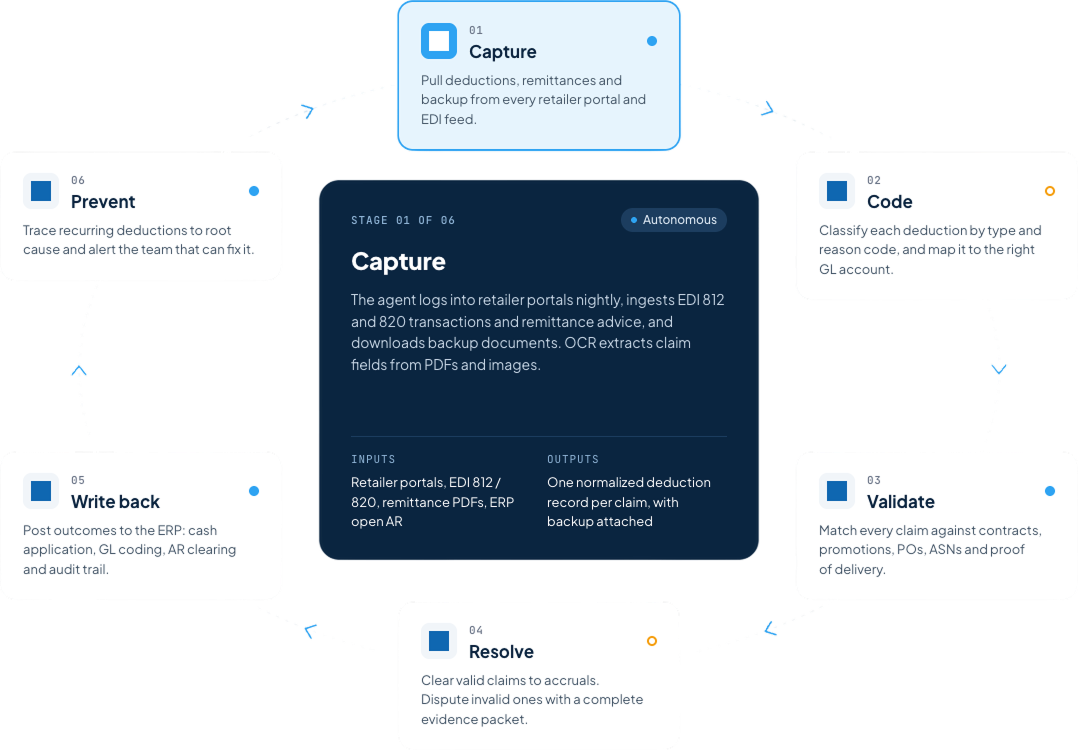
Capture. Agents collect deduction and remittance data from retailer portals and EDI feeds, along with the supporting documents: invoices, bills of lading, proof of delivery and promotion agreements. Everything is extracted and normalized into one format, whatever the source.
Code. Each deduction is mapped from the retailer's reason code to a standard category, such as shortage, pricing, compliance or promotion. Your team sees Walmart, Kroger and Amazon deductions in the same language. Anything the rules can't identify is marked "unknown" for review.
Validate. Each deduction is checked against the records behind it. Does it reference a valid PO? Does the invoice match what shipped? Does proof of delivery support the claimed quantity? Does the promotion deduction match the agreed terms? These questions have documented answers.
Resolve. Valid deductions are matched to the right account or accrual so they can be cleared. For invalid deductions, the system assembles the documentation each retailer requires, in the format and through the channel that retailer accepts, while the window is still open.
Write back. Coding, validation results and resolution status go back into your ERP, so AR, the general ledger and trade spend reflect reality. Retailer responses are tracked through to credit or denial.
Prevent. Deduction data is reported by retailer, reason, product, location and carrier. That turns repeat shortages, labeling fines and routing chargebacks into specific fixes for the teams that can make them.
Routine, well-documented cases move without analyst input. Your team keeps the cases that need judgment, such as complex promotional disputes or multi-shipment discrepancies. In our benchmarks, handling time drops from 40–45 minutes per case to 0–5 minutes.
What better deductions management delivers
Recovered margin matters, but for an enterprise vendor it's one outcome among several:
- Faster cash application and close. When deductions are coded and matched as they arrive, fewer items sit unapplied at month end.
- Capacity without headcount. Automating routine cases frees analysts for exceptions, analysis and retailer relationships.
- Accurate trade spend. Promotional deductions are matched to agreements, so sales and finance are working from the same numbers.
- Upstream prevention. Supply chain sees which deductions it's causing and can fix the cause instead of paying for it every month.
- Recovered margin. Invalid deductions are disputed completely and on time, including ones that were previously written off unseen.
The case for revenue owners usually rests on recovered margin. For finance, it usually rests on a faster close and on efficiency. It's the same system either way.
Working alongside SAP, Oracle, NetSuite and HighRadius
Enterprise 1P vendors rarely start from zero. Many run order-to-cash on an established ERP, and larger vendors often have HighRadius or a similar platform for cash application and deductions.
Valence isn't built to replace any of that. It's designed to be:
- Complementary. Valence adds retailer-specific coding, document-level validation and resolution support, then writes the results back to the systems your team already uses.
- Not a rip-and-replace. It connects to existing portals, EDI feeds and ERP data, so your core order-to-cash operations don't need to be re-engineered.
- No additional headcount. The work that currently needs more analysts is automated.
- New information, not another dashboard. It shows what each deduction was, whether it was valid, how it was resolved and what's driving it.
Built for enterprise review
Enterprise deployments are more often slowed by infosec review than by technical readiness. That's reasonable. Retailer portals hold pricing, contract and promotion terms that need protecting.
The platform is designed for that scrutiny. Data is encrypted in transit and at rest. Access is role-based. Each customer's data is kept separate. An audit log records every action, including who or what triggered it, which documents were attached and how the retailer responded. Auditors can rebuild the full history of any deduction months later.
What the first weeks realistically look like
Here's an honest timeline:
- Leakage analysis in two to three days, at no cost. Using a sample of your deduction data, we estimate your leakage percentage by retailer and reason code.
- Historical visibility. Up to two years of portal history can be ingested and coded, which shows deduction patterns your ERP wrote off.
- Retailer by retailer. Each new retailer portal connection takes roughly three to four weeks once credentials are provided.
- Full validation needs your data. Coding works from portal data alone. Validation also needs ERP and proof-of-delivery records.
- Retailer repayment runs on the retailer's schedule. Valence controls how fast and how completely deductions are resolved. Retailers control when credits are issued.
Time savings and visibility come first. Recovered dollars follow as disputes move through each retailer's cycle.
The real test
At an enterprise 1P vendor, the problem isn't a lack of process. The process is capped by how many hours your team has, and the ERP quietly absorbs whatever falls below the threshold.
The test for agentic AI in deductions management is whether every deduction gets captured, understood and resolved. It should clear the valid ones cleanly, dispute the invalid ones on time, and show the business why they keep happening, all inside the systems you already run and without adding headcount.
See what your deductions are really made of. Request a complimentary deductions leakage analysis and get an estimated leakage percentage for your retail accounts within two to three days.
Frequently asked questions
What is deductions management?
Deductions management is the end-to-end process of capturing, coding, validating, resolving and reporting the deductions retailers take from vendor invoices. It covers clearing valid deductions, disputing invalid ones and fixing the root causes of repeat deductions.
What is a 1P vendor?
A 1P, or first-party, vendor sells products wholesale directly to a retailer, such as Walmart, Kroger, Target or Amazon through Vendor Central, and the retailer resells them to the consumer. The retailer pays the vendor's invoice minus any deductions it takes.
Does Valence replace HighRadius or our ERP?
No. Valence works alongside SAP, Oracle, NetSuite and platforms like HighRadius. It adds retailer-specific coding, validation and resolution support, and writes the results back to your existing systems.
Which deduction types are most often invalid?
On average, OSND (over, short and damaged) and pricing deductions have the highest invalid rate, at roughly 35–45%. Co-op and trade promotion deductions run at roughly 3–4%.

